Domestic Policy, Immigration

Black (and all American’s) Lives and Futures Matter

I am for the square deal. But when I say am for the square deal, I mean not merely that I stand for fair play under the present rules of the game, but that I stand for having those rules changed so as to work for a more substantial equality of opportunity and of reward for equally good service.

Theodore Roosevelt, The New Nationalism, August 31, 1910

If the protests over George Floyd’s death and racial inequity are to mean anything, they must result in concrete and measurable improvements in the lives of disadvantaged communities. As corporate leaders try to virtue-signal their way past these changes, globalist elites are coming up with convenient excuses to avoid them such as this CNN article.  It disingenuously states that, since the world’s population will peak before the end of the century, America needs to continue its relaxed immigration policies.  It glosses over the fact that the population will continue to increase for the remainder of this century and so will drive more cheap immigrant workers here in the foreseeable future. It essentially accepts high economic inequality as a cost of a strong economy.  At best, this is another example of Wall Street’s short-term thinking and, at worst, simply a way to continue exploiting the current system for personal profit.

 A better way is highlighted in a CNBC interview of African-American investor Jim Reynolds highlighted in Alan Tonelson’s RealityChek weblog. See the July 12 entry on Alan’s blog for more. It points out that, if those companies stopped importing H1B visa technical workers and started developing and investing in students and workers here at home, they would create more opportunities for minority workers.  Indeed, this would apply to all Americans, regardless of race, creed or color.  Of course, this would require real money and effort from those companies, not just a well-worded press release.

Theodore Roosevelt knew that America could not be strong unless its people were strong and our people could not be strong unless they were given a “square deal” by our economy. It is a principle that is colorblind, and also a threat to the privileged few.  Changing our current immigration system is a critical element to achieving it for the average American.   
Antitrust & Trade Regulation, Domestic Policy, International Trade

Building American National Security and Good Jobs

https://www.theamericanconservative.com/articles/how-to-change-the-rules-of-trade-to-bring-manufacturing-home/

No [tariff] duty should be permitted to stand as regards any industry unless the workers receive their full share of the benefits of that duty. In other words, there is no warrant for protection unless a legitimate share of the benefits get into the pay envelope of the wage-worker.

Acceptance  Speech to the Progressive Party Convention, August 6, 1912

Reshoring manufacturing and vital supply chains after decades of neglect was always going to be a difficult process.   This article is a good primer on how to do it and the kinds of issues that must be addressed to harden our economy against shocks like COVID-19.  Trade agreements that prevent us from favoring local production may have to be abrogated and domestic policies that empower workers will be necessary to prevent the benefits from flowing primarily to Wall Street rather than workers.  The article also proposes some radical changes in labor relations to achieve this goal, but minimizes or misses two other necessary policy changes. 

We learned in the aftermath of FDR’s New Deal that protected industries can easily slide into anti-competitive practices that create monopolies.  The article advocates direct regulation rather than reviving antitrust laws to prevent this, which was actually the approach TR took in his New Nationalism speech in 1913. However, the 2008 financial crisis showed us behind-the-scenes regulation can be captured and then neutered by the very industries it is trying to control.  New and robust antitrust laws enforceable in the courts would add transparency to the process of controlling this market power.

The article also fails to mention the importance of education and training.  As the author points out, the jobs of the future will require high-level technical skills to create the kind of superior products that command correspondingly high salaries. All levels of government should increase their support for the community colleges and quality vocational tech schools that will be required to provide the necessary training.  In the end, our education system and employers will need to develop lifelong learning mechanisms to keep American workers competitive with the rest of the world’s workers. 

Americans have the talent. They just need a government that will give them the skills and the opportunity to succeed.     

General, Politics

Preserving Theodore Roosevelt’s Legacy in the Modern Arena

[We] have the right to express our pride in what our forefathers did, and our joy in the abundant greatness of this people.  We have the right to express those feelings, but we must not treat greatness achieved in the past as an excuse for our failing to do decent work in the present, instead of a spur to make us strive in our turn to do the work that lies right at hand. If we so treat it, we show ourselves unworthy to come here and celebrate the historic past of the nation.

Theodore Roosevelt, Fourth of July speech at Huntington, New York, July 4, 1903

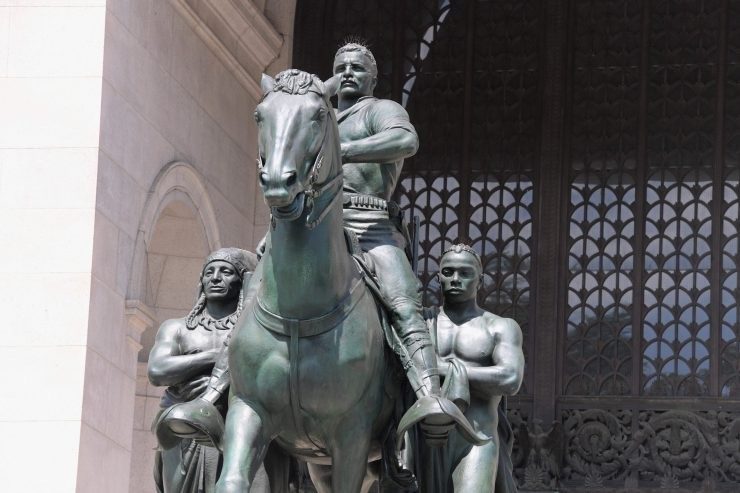
The quest for national American unity animated Theodore Roosevelt for his entire life. Growing up during the Civil War, the six million dead of that war and the sectional divides that led to it were always on his mind and those of his fellow Americans during the generation afterwards.  TR was well aware of the racial and ethnic divides that also existed and, as “the man in the arena”, tried to keep those divides from creating similar divisions as much as the arena of his times allowed. Today, those racial and ethnic divisions pose the greatest threat to national unity.  The removal of the equestrian statue in front of the American Natural History Museum in New York City needs to be viewed as a gesture toward healing these divisions and achieving a modern national unity.

As shown in the above picture, the statue features Roosevelt on a horse flanked by standing American Indian and African-American figures.   It has been a flashpoint with black and Native Americans for years because the two figures at the side appear to be subservient.  The museum cited this depiction of Roosevelt as the issue and recognized his contributions as a natural historian and conservationist by renaming their Hall of Biodiversity after him. Even the Roosevelt family agrees with the decision, saying that the statue does not represent his true legacy. 

The quotation above better reflects that legacy. While TR’s personal views on race were unfortunately common during his era, he also acted to promote and protect racial equality as much as a Congress made up of segregationist Southerners and conservatives would allow.  He supported the Lodge Federal Elections Act of 1890, an early form of the modern Voting Rights Act that would have protected African-American voting rights in federal elections.   As New York governor, he pushed through legislation banning racial segregation in public schools. These stands, and many similar ones, were significant accomplishments for that era. 

At the same time, each generation has the right to determine who and what will be celebrated in the public domain. The removal of Confederate statues and names from majority African-American cities and military bases represents this natural transition.  However, these decisions come during a frightening time when mobs attack the legacies of not only TR, but also George Washington, Thomas Jefferson and other authors of the very rights in which those mobs claim to believe.   It is a mark of mindless extremism born of a failure to appreciate the historical context – the “arena” – that these figures lived in. The concept of equal opportunity, human rights and democratic government espoused by our founding fathers were dangerous to the elites of their time and, but for their courage, might not exist today.  We must avoid flushing those memories and accomplishments down a modern-day Orwellian “memory hole”, for that way leads to the totalitarian world we all oppose.

In a statement released today, the chairman of the congressionally-chartered Theodore Roosevelt Association put it well when he said “Theodore Roosevelt’s contributions to the United States and legacy is more enduring than any statue”.  If we concentrate on the positive aspects of that legacy and those of other American heroes, we will continue our common national march to the more perfect achievement of those great ideals.