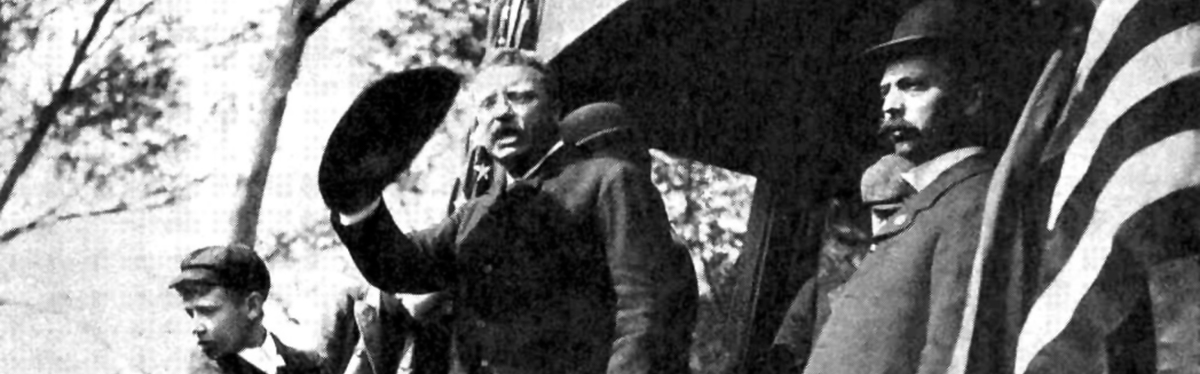
The nation is relieved that former President Trump survived yesterday’s assassination attempt. However, an audience member was killed in the attempt and another injured. They and their families should be in our thoughts and prayers. The photo of Trump defiantly raising his fist before the flag recalls Theodore Roosevelt’s defiance of the attempt on his life during his 1912 presidential campaign, famously declaring that “It takes more than that to kill a bull moose”.
I lead, however, not with that quote, but with Roosevelt’s equally famous “Man in the Arena” speech, where he calls all Americans to embrace the risks of action and the kind of “dust and sweat and blood” that Trump defied. This call does not necessarily mean a call to enter politics ourselves, but to the kind of courage that those who fight for our country here or overseas live daily. This injuries and deaths at the Trump rally now call us to a new fight for our political life here at home.
Over the past few years, our political debate has coarsened and polarized to the point where violent rhetoric has become shamefully common. Only last week President Biden promised to put his opponent Trump “in the crosshairs”. A poll in the New York Times revealed that 10% of respondents believed violence was justified against Trump and a similar percentage believed the same about President Biden. The rest of us have seen all of this and either shrugged our shoulders or remained silent out of fear.
We can no longer be among the “cold and timid” who assume this is someone else’s problem. It is time to summon the courage to confront calls to hatred and violence in the political arena and ostracize those who engage in them. Media outlets that feature or promote them must be shunned and boycotted. Finally, each of us must have the courage to confront friends and acquaintances who engage in such hateful rhetoric and ostracize them as well. If necessary, we should not hesitate to report them to law enforcement if they pose an imminent threat. Otherwise, the hatred will not only worsen, but we will also then be complicit in what happens afterwards.
America has faced and conquered crises over its history that have destroyed lesser nations. The common cause of these crises was the concentration of power in an elite whose outsized privileges threatened our democracy. Whether it was British colonialism or the “Slave Power” of southern aristocracy, the key to its durability has been our confidence in the morality of our fundamental ideals and commitment to spreading opportunity to all Americans. This commitment never was implemented in a straight line and many Americans were left out for too long, but we always had the confidence that we would eventually prevail.
Theodore Roosevelt never forgot that he became President because of an anarchist’s bullet during a similar period of economic inequality and protest. Criticized as a radical because of his progressive ideals, he always insisted that they were intended to preserve the legitimacy of American free enterprise against more radical and dangerous policies. TR knew that America could not be strong unless the American people were strong, and Americans could only be strong if they saw a better future for their children. If we are to survive as a beacon of democracy, we must have courage to confront and conquer the current crisis in the American spirit. We start by looking back and determining how we lost our sense of American community and shared commitment.
Next – The Confrontation with the Concept of limits
Early Americans were blessed to grow up without a real sense of limits. After all, an entire continent beckoned before them, offering challenges that occupied the country for almost three centuries. Those frontiers, however, were less important than the values frontier eventually enshrined in the Declaration of Independence and the Constitution. It is too easy to forget how revolutionary the concepts of democracy and basic human rights were in a world that remained hostile to those ideas well into the nineteenth century. Pushing this frontier forward was as exciting and dangerous as expanding the land frontier. It involved personal and national sacrifice to tame and develop these new frontiers. The failure to address the contradiction of slavery forced the nation into a bloody civil war. Nevertheless, these frontiers created an optimistic spirit that animated American life and gave the Americans the feeling they were creating something new through the first century of the nation’s life.
The closing of the American land frontier in the 1890s initiated a serious debate about American goals and meanings. The country was then in the middle of an Industrial Revolution creating once again a new, apparently limitless economic frontier of productive innovation. It also created a new challenge for American values frontier. The new industries absorbed immigrants fleeing the same economic and political turmoil as the original settlers but offered more stifling careers and a dangerous level of socioeconomic inequality threatening those values. Enter Theodore Roosevelt, who served as the perfect bridge to this new economic frontier. His life spanned the two worlds of Western pioneering and urban industrialization. He also never forgot that he became President because of an anarchist’s bullet and so sparked an era of progressive legislation that gave new hope for fairness for the average American in the new economy. The America he left behind had renewed its confidence and a sense of limitless vistas as it entered the twentieth century.
American leadership in productivity and innovation led to both increasing international influence and socioeconomic strain that thankfully found a new bridge leader in TR’s cousin Franklin D. Roosevelt. Economists still debate how effective the New Deal was in countering the Great Depression, but FDR’s program clearly lifted the spirits of the country. The advent of World War II not only provided the economic improvement promised by the New Deal, but also ushered in a beguiling new frontier of international influence. The US now had the ability to pursue two of its historic frontiers simultaneously – the expansion of American values across a global land frontier. The fight against fascism and then communism justified the sacrifices involved, but also contained a Pandora’s box of temptations to overreach and hubris.
For almost fifty years after World War II, this Goldilocks period of unlimited American power seemed unstoppable. In fact, the economic and international influence frontiers were slowly closing behind us beginning in the 1970s. The European and Asian economies devastated by the war retooled with more efficient innovative industrial facilities and, in many cases, better educational systems that allowed businesses and workers to move up the value chain and win better wages. Meanwhile, the American industrial system stagnated and lost capital investment to new high tech and information companies. This seemed to revitalize the economic frontier for a time, only to find out how easy technological change was to duplicate, steal or exploit for sinister use. Similarly, the limits of our international power were illustrated in the Vietnam War, but then apparently renewed by the collapse of the Soviet Union and the victory in the 1990 Gulf War. This ushered in the triumphant claims of a New World Order in which the US would lead the world to the new heaven of liberal values and economic bliss.
In truth, this was all being supported by policies that mortgaged the real future to sustain the illusion of an unlimited future. Our political leadership defied TR’s warning and deceived people into believing that these unlimited vistas could be achieved with no real sacrifice. Tax cuts and government spending covered up the decline in incomes while overseas business investment slowly increased. As a result, the US went from being one of the 5 lowest debt-to-GDP countries in 2000 to one of the top 5 highest in only 23 years. The 9/11 attacks spurred a quixotic Global War on Terror that committed the nation to further military spending and long, poorly thought and fought wars in Afghanistan and Iraq. The desperate futility of these policies was covered up by triumphalist rhetoric and a financialization of the economy that led to increasing inequality. Instead of TR’s call to visionary sacrifice, the American people were encouraged to act like kids in a candy store who, when asked which piece of candy they would like, respond with “I want it all!”
So now we face the end of the era of unlimited economic and international power without the tools to bridge to the next era. The drop in economic productivity due to our failure to invest in education and infrastructure makes it more difficult to maintain our standard of living and raise the necessary internal capital to keep up with the rest of the world. The rise in debt is corroding the dollars’ status as a reserve currency – an important source of international power. Meanwhile, China and the BRICS of the Global South are ushering in the new G-0 world of diverse powers that can chart their own destiny without us and create new rules of order more compatible with their own interests.
A modern bridge leader would have convinced the American people to invest in themselves through education and industries at home, avoided the weakening adventures abroad, and called us to new visionary, but achievable, frontiers at home and in our foreign policy. Why didn’t this happen? Part of the reason is found in history, and not just one – the subject of the next post.