
I believe that war should never be resorted to when, or as long as, it is honorably possible to avoid it. I respect all men and women who from high motives and with sanity and self-respect do all they can to avert war. I advocate preparation for war in order to avert war; and I should never advocate war unless it were the only alternative to dishonor.Theodore Roosevelt, “America the Unready”, Theodore Roosevelt, An Autobiography, 1913
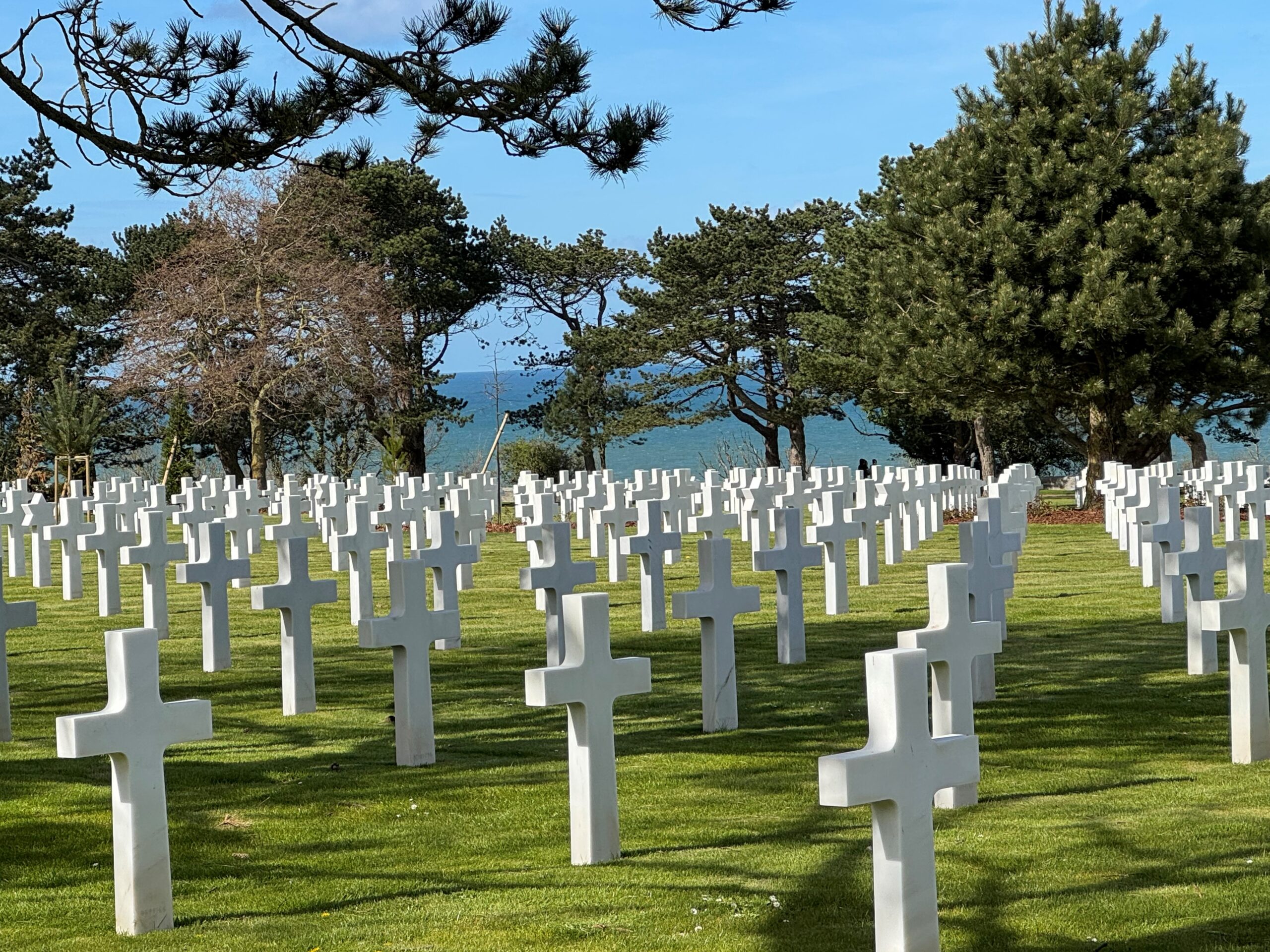
I recently had the somber honor of visiting the American cemetery in Normandy, France. One cannot look out over the sea of white crosses stretching toward Omaha Beach without thinking of the hopes and dreams of the young men who never made it past that spot on D-Day. Two of Theodore Roosevelt’s sons – Theodore Jr., and Quentin – rest amidst those crosses. It forces you to confront the cost of war and why Theodore Roosevelt’s respect for those who try to avoid it should command our respect as well.
Donald Trump should have made a pilgrimage of his own to this site before he began our current war against Iran. Perhaps this somber memorial would have made him reconsider the need for this war or at least identify a clear objective and then convince the American people of its necessity. Instead, he unilaterally embarked on another forever war that strains American resources, trashes our reputation, and thus our influence in a region far from our own shores.
In my series “Nationalist Foreign Relations – A History”, I said the world was moving from a period of great power rivalry to a world where there are no superpowers. By beginning this war, President Trump has recklessly accelerated this process. A prudent stewardship of our domestic, economic and foreign assets would have positioned the US to be the “great balancer” in a world of diffused power. Instead, President Trump has essentially declared war on the world by our blockade of Iran and is exhausting our economic and military assets in prosecuting this conflict. The net result will likely position China, not the US, as the great balancer in a world newly desperate for security and respect.
In an uncharacteristic display of legal humility, Trump has not tried to cloak the war under the provisions of the Global War on Terror authorized after the 9/11 attacks. On March 2, he sent Congress the notice of the conflict required under the War Powers Resolution, thus triggering a process that would force a justification of the war. Congress must pass an Authorization of Military Force (AUMF) by April 29 for it to continue. If it doesn’t, the President must begin the process of withdrawing American troops, which must be completed within 30 days.
The two sides are far apart in their negotiations, so the conflict will still be raging in some form by the April 29 deadline. The President may claim we are winning and that peace is at hand. He will try to shame Congress into authorization by saying they must support the troops in combat. If these shibboleths don’t work, he will resort to the time-honored tactic of claiming American credibility is at risk.
The congressional debate will try to define the true and achievable goals of this war. It will also highlight the monetary costs to the federal government and identify how we will raise the money to pay for it. It will also discuss the impact of this war on the American consumer and the world economy. However, it will also be about something even more fundamental and critical.
It will be a debate about America’s soul.
This war is a matter of choice, grounded in an unsustainable globalist assertion of military supremacy. Like the little Dutch boy, Donald Trump is using our precious and dwindling resources to vainly plug the breach in the dike of American unipolarity in a multipolar world. The reasons have ranged from ending Iran’s nuclear program to establishing a new American hegemony over the Persian Gulf to control China. The former injects American power into the Middle East in a way that benefits only Israel. As the Israelis put it, we would regularly sacrifice American lives and money to help them in “mowing the grass” of Arab resentment, all for little advantage to ourselves. At best, it is a form of liberal interventionism that would make even Barack Obama blush. If global hegemony is the goal, any immediate gains will come only through an exercise in naked power and will thus reek of fascism. Such a war betrays the principles that have been the bedrock of our soft power and will damage our long-term security and influence in the world for decades.
The easy vote would be to gloss over all this and succumb to the siren song of “support the troops.” Opposition would be condemned as surrender, and opponents as terrorist sympathizers. In response, progressive nationalists should quote Donald Trump’s promises to end forever wars like this and focus on rebuilding our own country. They should point out that Iran’s assertion of control over the Straits of Hormuz has already met with strong opposition from European and Asian nations. We can support a truly multinational effort to enforce maritime law and reopen the Strait of Hormuz. As for nuclear weapons, the damage caused to Iran by the war will set back any Iranian program by 5-10 years. Even in the worst case, a nuclear Iran would simply create a new balance of power in the Middle East against Israel’s nuclear capabilities. The history of the Cold War and the India-Pakistan standoff shows that such a balance can actually calm conflicts rather than cause them.
More importantly, a defeat of an unrestricted Iranian AUMF would reassert the primacy of Congress‘s war powers. It would draw a constitutional line in the sand against further erosion of Congressional authority, in the backdrop of a conflict that has little impact on our national security. There may never be a better opportunity to preserve the necessary checks on Presidential war powers than now.
The upcoming debate will be among the most significant in American history. Is war still America’s last resort in international disputes, or will it now become our first resort? During that debate, House and Senate members would do well to remember the soldiers who lost their lives on D-Day and are memorialized by the white crosses of Normandy. They gave their lives believing America stood for freedom and peace. Congress will soon decide whether it still does.